I am born in Hong Kong and lived there for 15 years, until my family moved to Vancouver in 2022. In Chinese, my name Lok Tin (樂天)
means optimistic. It just so happens that I am not usually disappointed or saddened by a situation for too long. Although it does
depend on the situation, I am generally quick to move on and attempt to see things in a different light, perhaps a better, more optimistic
light. My parents never gave me an English name. Lok Tin has much more meaning than a generic English name, and reminds me of my roots.
Even if I could change my name now, I would still prefer Lok Tin.
Note: Do not simplify my name to Lok. My sister is called Lok Yee, and merely Lok would not differentiate me from her.
The number of times I have been called Lok by teachers/professors is rather irritating. Lok alone means joy, but that is
not me. I am Lok Tin.
I may not be immune to procrastination, but when I am locked in, or in other words, focused or in the zone, I can make great progress in a
short period of time. I do not normally use internet slang, but locked in is my high school namesake, for it sounds just like Lok Tin. I treat
it as a compliment, or a reminder to stay on top of things. I take pride in completing tasks ahead of time; fighting deadlines is not preferable for me.
I would call myself a good listener, staying silent as needed and not speaking out of place. I do not normally dominate conversations and make myself the centre
of attention. Instead, I try to give everyone a chance to speak while making my own contributions. In the case of group work, I am careful to credit each member;
I would much rather share the spoils than to take it all for my own.
Long before we had the idea to leave Hong Kong, my parents have always provided me with many opportunities to learn English,
from books, kindergartens with foreign instructors, to Skype lessons taught by a South African teacher. I would specifically
credit this Skype teacher, along with my parents for my current proficiency in English. I can speak fluent Cantonese and English,
as well as intermediate Mandarin. I can write in Traditional Chinese and English. I cannot write in Simplified Chinese, but I can
interpret some of their characters.

Reading
I have been reading since I was still drinking milk from a baby bottle, thanks to my parents
seeing great value in books. Horrid Henry and Diary of a Wimpy Kid were some of my favourites.
Now, I enjoy reading both fiction and non-fiction. Fiction includes Percy Jackson, Tom Clancy,
and The Horus Heresy. Non-fiction is mostly centred around history, a passion of mine, but also
books about daily-life physics and firearms (educational purposes only).
History
History is my passion. I am into the idea that we can learn from our mistakes in history, even if
history is rather cyclical. Although I major in Computer Science, I have still taken
history courses in my first two years of university, to further my knowledge. I have not quite decided
which aspect or time period of history I am most interested in, but I am leaning towards military history.
I listen to a Swedish metal band, Sabaton, that sings about war stories and correlates with my
passion.
Programming
My first exposure to programming was playing around with Scratch in primary school, making simple
platformer games and a dance sequence with several photoshopped frames. Later in secondary/high school and
my first year of university, I worked on bigger projects with HTML and CSS, JavaScript, and Java.
Video Games
I enjoy playing single-player games, especially ones with a story. Examples include Grand Theft Auto V,
Watch Dogs 2, and The Witcher 3: Wild Hunt. Playing through a well-crafted story gives me the same,
if not more satisfaction than reading a fictional novel. In a text-based role-playing game called Torn,
I have met a group of great friends. Together, we have built a community of over 200 players in the span of two years.
I get to use my programming abilities and Discord expertise to assist the operation of the said community.
Video Editing
I have a YouTube channel of six years with over 200 videos (including the vast majority that I have set to private).
I used to enjoy recording my gameplay, editing them into videos and uploading them to my channel. With my abilities,
I have once helped my mother to edit a video of her giving a lecture about Speech Therapy.
Writing
Reading and writing came hand in hand. As I enjoy reading stories, I also relish in writing my own stories, mostly inspired
the books I read, the games I play, and military history in general.
Kindergarten
Fun fact: I have studied in 3 kindergartens.
Primary School (Grade 1 to 6)
Kau Yan School, Hong Kong.
I have very vague memories of using Code.org and Scratch to learn basic block-based coding. I particularly
remember the Minecraft Hour of Code activities. They were designed to take around an hour to complete, and I recall
finishing them quite quickly.
Secondary School (Grade 7 to 10.5)
Creative Secondary School, Hong Kong.
In these 3.5 years, I spent more time with Scratch, picked up HTML and CSS, and even had a very brief experience with Unity.
I remember dedicating a lot of time into Scratch outside of class, collaborating with online users to make small games.
High School (Grade 10.5 to 12)
Pinetree Secondary School, Coquitlam, BC, Canada.
My first official volunteering experience was during high school. The requirement to graduate was 30 hours, but I ended up
logging 51 hours of picking up garbage, gardening at the Town Centre Park, and removing invasive plants in a nearby creek.
Computer Programming 11 and 12 taught me the basics of Java, which was really helpful for first year in university. I made
console-based games and later got to recreate Pong and Snake in JavaFX.
University
The University of British Columbia, Vancouver, BC, Canada.
I finished my first year in UBC with a 87.8 average, taking three Computer Science (CPSC) courses over two
terms. CPSC 110 was particularly difficult as it was my first exposure to recursion. I started the course grumbling about
the lectures but later understood the concepts through hard work. As a wise man once said, "Just trust the natural recursion!"
I saw more use with Java in CPSC 210, learning how to make programs composed of multiple files and with a fully-functional GUI.
ColtCobra
Made this as my online username over six years ago. I searched for "cool gaming usernames", found Colt and Cobra next to each
other on the list, and pieced them tegether.
Per5eus
Inspired by Perseus, the Greek hero, and Percy Jackson. Replaced the first s with a 5 because Perseus was taken and
5 resembles s.
LokSn
The chemical symbol of tin is Sn. LokSn is LokTin (my actual name is Lok Tin, with a space in between, but usernames often do not allow
spaces).
Interested Intellectual Properties
Warhammer 40,000
I was first exposed to Warhammer 40,000 (W40K) in November 2024. One night, I was sitting in my dorm room and searching for "battle ambience" on YouTube,
when I came across this video. Prior to
that, my only knowledge of Warhammer 40,000 was chubby armoured soldiers with guns of unrealistic proportions. This probably explains why I never
got into W40K earlier; their warriors did not look quite right (or like us people). Later, I would know that these soldiers are "Space Marines", and their
guns are called "Bolters". I then learned that Space Marines are not at all chubby in the lore, but actually seven to eight-foot-tall supersoldiers,
genetically modified to unbelievable extents— three lungs, two hearts, ability to ingest brains and absorb the memory contained within, not to mention
enhanced senses and reaction. W40K seems to take everything to the extreme, and I fell in love with it.
Ever since November 2024, I have read countless pages from the Warhammer 40,000 Wiki,
supplemented with YouTube videos that explained the vast lore. I searched the internet for official and fan-made W40K animations.
Pariah Nexus. Angels of Death. Astartes. Iron Within. The Tithes. Kill Lupercal. I have
enjoyed them all. For CPSC 210, my project was a "database" that allows storing information of W40K characters. On the music side of things,
I began listening to W40K ambience or soundtracks from W40K games. I picked up a few Horus Heresy books, finishing five and currently
reading my sixth. That is 2,300 pages in fourteen months, at the time of writing. I even bought two JoyToy Ultramarine figures; each are
about twelve centimetres tall with flexible joints and two to three replaceable weapons. If I had a better computer, I would play
Warhammer 40,000: Space Marine 2. Needless to say, Warhammer 40,000 became an integral part of my life.
In the grim darkness of the far future, there is only Warhammer 40,000.
SCP Foundation
First introduced to SCP-173 by a friend in Grade 7.
Years later, I decided to give SCP - Containment Breach a try. It
was the first, and probably the last horror game that I have played. Regardless of whether I enjoy horror games or not, I am mesmerized by the different
SCP objects created by internet users. How people can come up with bizarre, unprecedented anomalies is beyond me, and I love reading their entries.
Though they are certainly strange, they feel somewhat relatable— the kind of unexplainable anomalies that you may have imagined in your nightmares.
Never-ending staircases, creatures that go beserk if you catch a glimpse of their face, recurring hallways, an infinitely-large IKEA that you cannot
escape from, etc.
If you are confused, an SCP object is a fictional anomalous phenomenon, object, location, or individual. Each of their entries— a visual description of them
and how they should be contained— is just like a short story of several hundred words. I recommend giving them a read.
I still have nightmares of SCP-106 phasing through walls and pulling me into his pocket dimension.
Mortal Kombat
I am unsure as to how I got hooked on Mortal Kombat, for I have not played games of the franchise myself. Perhaps thanks to theRadBrad, I have seen all
the cutscenes in the Mortal Kombat 11 (2019) and Mortal Kombat 1 (2023) games. I have also watched the 2021 Mortal Kombat film on a flight to Hong Kong.
What exactly interests me? I think it is the character design that caught my attention. Each of them has unique abilities and appearances that are quite
distinguishable (and memorable!). Kitana has boomerang-like fan blades. Scorpion has multiple different looks across the franchise, but most remembered
for his chain dart and fire attacks. Liu Kang and his "bicycle kick". Johnny Cage's "nut punch" and his humour. You get the idea.
Opinion on Generalizations
Let's just get this out of the way. Don't generalize. There may be cases when generalizations are useful, like marketing tailored to a certain audience
assumes that this group of people would generally find a specific product appealing. However, generalizing is more often harmful than beneficial.
For example, if there is a video of a man shamelessly cheating on his partner, does this imply that all men are disloyal? If a car accident involves an
Asian, does this mean that Asians can't drive properly? I find that wild generalizations are often made to justify one's existing prejudice against
others. Don't do that. If we want to unite and reconcile, don't generalize. Judge each individual by their behaviour and not by the behaviour of others
in their group.
As one spends sufficient time on social media, one begins to understand that certain choices of wording can provoke certain reactions, even if the intention
is not necessarily to rile people up. Let us use the aforementioned car accident example. Compare these two possible titles for a video that shows the accident:
Person Gets Into Car Crash
Asian Gets Into Car Crash
Which of the above is potentially provocative? By provocative, I don't mean that Asians would be enraged by the title. What I mean is that the title evokes
prejudice against Asians, giving keyboard warriors an opportunity to generalize. "Asians can't f**king drive." I can already see it.
Phrases to avoid:
- "Most people cannot appreciate..."
- "This generation..."
- "Men/women are like this."
My Geography instructor made the mistake of using the first phrase. Has she talked with most people to know that they don't appreciate the
importance of healthy soil? I think not. It is merely an assumption on her part.
Quite impossible for an individual to have met most people in the world, eh? Yet, we all make generalizing statements
about the majority. Makes no sense.
Opinion on Logical Fallacies
Ever since taking CPSC 121 and SCIE 113 in UBC, I have been quite hooked on logical fallacies and how often I see them every day, particularly on social media.
According to the 16Personalities test, I am a Logistician (ISTJ-T), which probably explains my obsession with fallacies.
Before we begin, I should acknowledge that we all make logical fallacies from time to time. I obviously do, although I try my very best not to. I am not perfect,
but I still think that I can bring a positive change to the world with my words, by, for example, raising awareness of logical fallacies.
If you want to make a good argument, be logical. Yes, I know, pathos is a powerful persuasion technique since we all have emotions, but I believe
that logos eventually prevails. I don't have a problem with pathos, given that it supplements logos. You may notice me using pathos later on.
I am going to list several logical fallacies and explain why each of them is problematic.
Fallacy: Criticizing or outright insulting the opponent to make one's argument seem superior. In other words, the ad hominem fallacy.
Problem: I can understand why you might be tempted to do so. If you can paint the opposition as an unreliable source, say, a terrible person, people may reject
their ideas and prefer yours instead. Think about this though. When we elect a leader to speak and act on our behalf, we want an individual that actually
does things for the people, and not simply because their opponent is supposedly unfit. Just because candidate A makes candidate B sound like a fool does
not mean that candidate A is the right person to pick. I am sick and tired of Liberals and Conservatives or Democrats and Republicans repeatedly discrediting
each other, without justifying why they are the better party to support. Immature kids bickering to no end. What are we paying them for?
Fallacy: You see ten consecutive videos that all show women cheating on their partners. Hence, you conclude that most/all women are cheaters.
Problem: Good old generalization, but there are actually multiple problems here. First of all, one cannot even deduce the legitimacy of said videos.
Content on social media are often faked to provoke viewers. That's pathos. Secondly, even if all the videos are real, how does the behaviour of ten, a hundred, or
even a thousand women reflect the behaviour of most or all women? You cannot extrapolate from such a small set of data; a memorable quote from SCIE 113. To conclude that the majority follows a trend,
one would have to analyze the majority, which is near impossible. Although statistical inference is a thing, to make generalizations of people's character is doing them injustice.
Therefore, when judging people, you can only draw conclusions of the individuals that you have studied. The last problem is the social media algorithm.
Some may think that if they are frequently shown videos of some behaviour of some people, it is likely that said behaviour of said people is true. "Women cheat. I see it all the time on Instagram Reels."
This is doubly wrong. Not only is the frequency of which you are shown something unrelated to its legitimacy*, social media algorithms often suggest topics that you've
seen in the past. It does not mean that videos of women cheating are "common". The algorithm just feeds you what you want to see, creating what is called a confirmation bias.
Fallacy: Either he is this, or he is that.
Problem: "Only a sith deals in absolutes." Excellent quote. What I'm trying to say is, there is more to a person than just two possible extremes. Just because I am not
a Conservative does not mean I am a Liberal. I can be neither.
Fallacy: Is a kilogram of steel heavier, or is a kilogram of feathers heavier? The answer is steel, because steel is heavier than feathers.
Problem: Do not change the question. We are asking, is a kilogram of steel heavier, or a kilogram of feathers? We are not
asking if steel is heavier than feathers**. It is incorrect to change the opposition's argument in order to better counter it.
Fallacy: If it rains, I will bring an umbrella. Ah, okay, so if it doesn't rain, I won't bring an umbrella.
Problem: If P then Q is not the same as if not P then not Q (its inverse). If P then Q only
tells you that Q is true if P is true, but not what happens if P is false. You cannot make any conclusions if P is false. In this case,
we don't know whether or not I will bring an umbrella if it doesn't rain.
Fallacy: If it rains, I will bring an umbrella. Ah, okay, so if I bring an umbrella, it must be raining.
Problem: If P then Q is not the same as if Q then P (its converse). I can bring an umbrella even if it
is not raining. The only way to contradict my original logic proposition is if it rains and I don't bring an umbrella.
Fallacy:
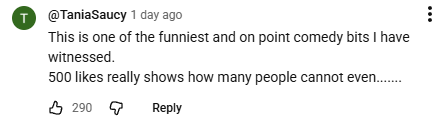
Interpretation: TaniaSaucy thinks that the video deserves more than 500 likes, and the lack of likes show that people
don't understand/appreciate the said piece of comedy.
Problem 1: Just because people don't press the like button does not mean they don't understand or disagree with
the video. I often find myself neglecting the like button, forgetting that it exists. It also explains why YouTubers
always remind their viewers to like their videos in show of support.
Problem 2: The significance in the number of likes a video gets is relative to the number of views. 500 likes in just a few thousand views
(1 like per 10 to 15 views) is not bad at all, where 500 likes in a million views (1 like per 2000 views) is a different case. Simply listing
a statistic without disclosing other relevant statistics can be misleading.
Problem 3: Again, the algorithm is not considered. The reception (number of views, number of likes, or views per like) of a
video depends if the algorithm can suggest said video to people who are likely to find it interesting. If the algorithm hasn't shown me this
video, I cannot come to appreciate it because I don't know of the video. It does not mean that I (or the general public) am incapable of
understanding the video. It just means that I haven't seen the video yet.
Conclusion: "500 likes really shows"... Nope. Tania, I will stop you right here. 500 likes doesn't show anything.
I think you get the idea. It is difficult to be completely immune to fallacies. I am certain that I will make many mistakes in future arguments, but hey, at least
I self-reflect and know what to look out for.